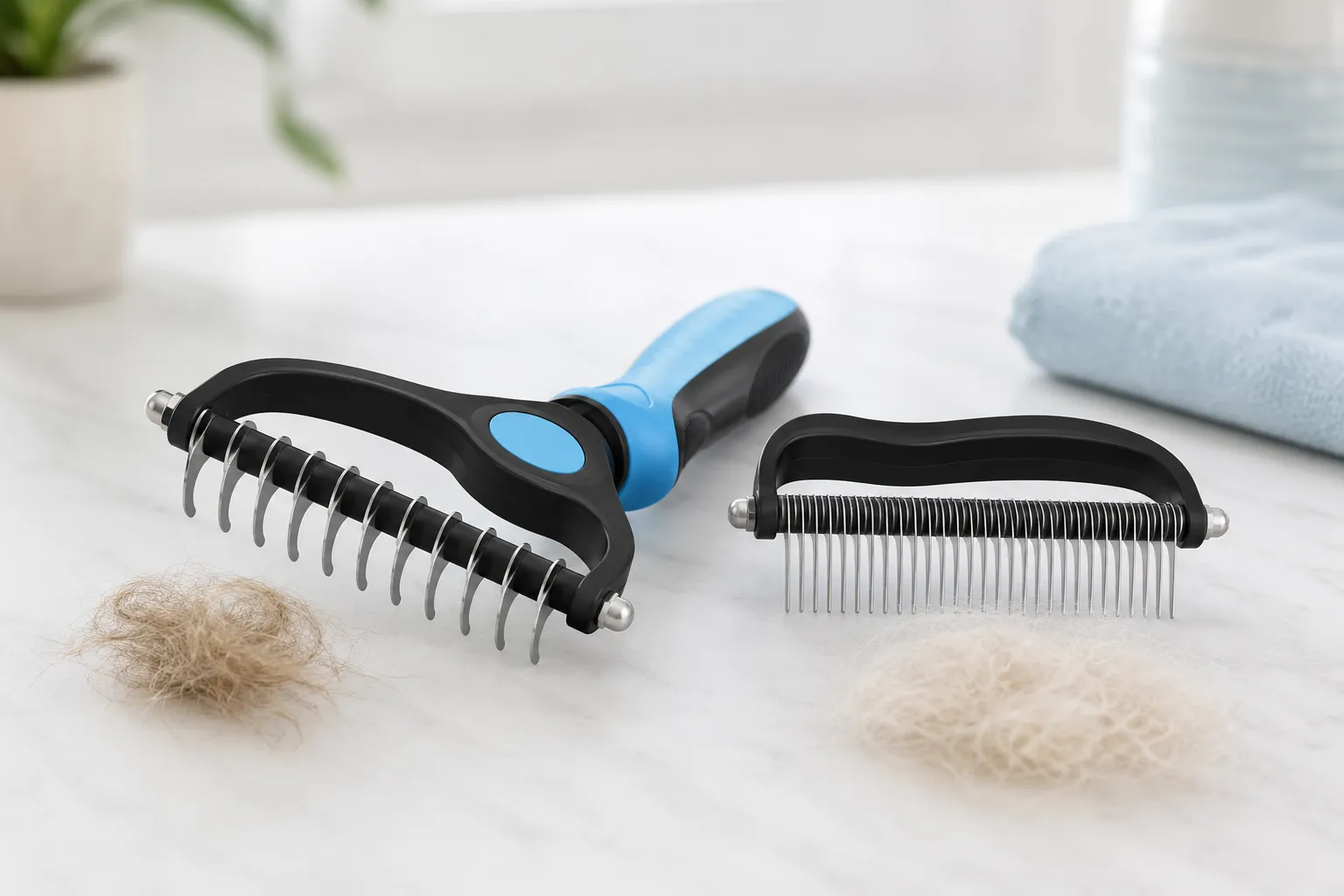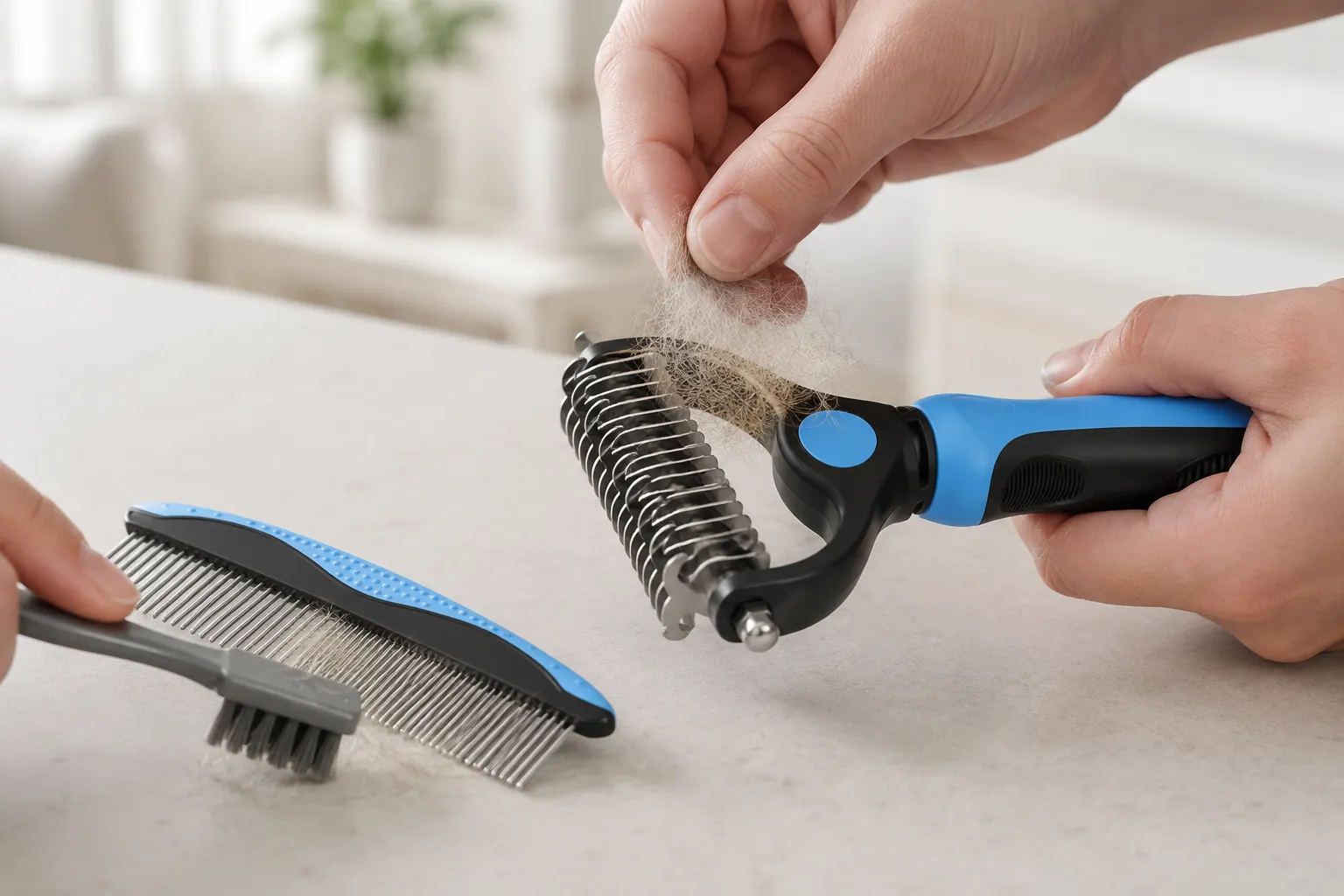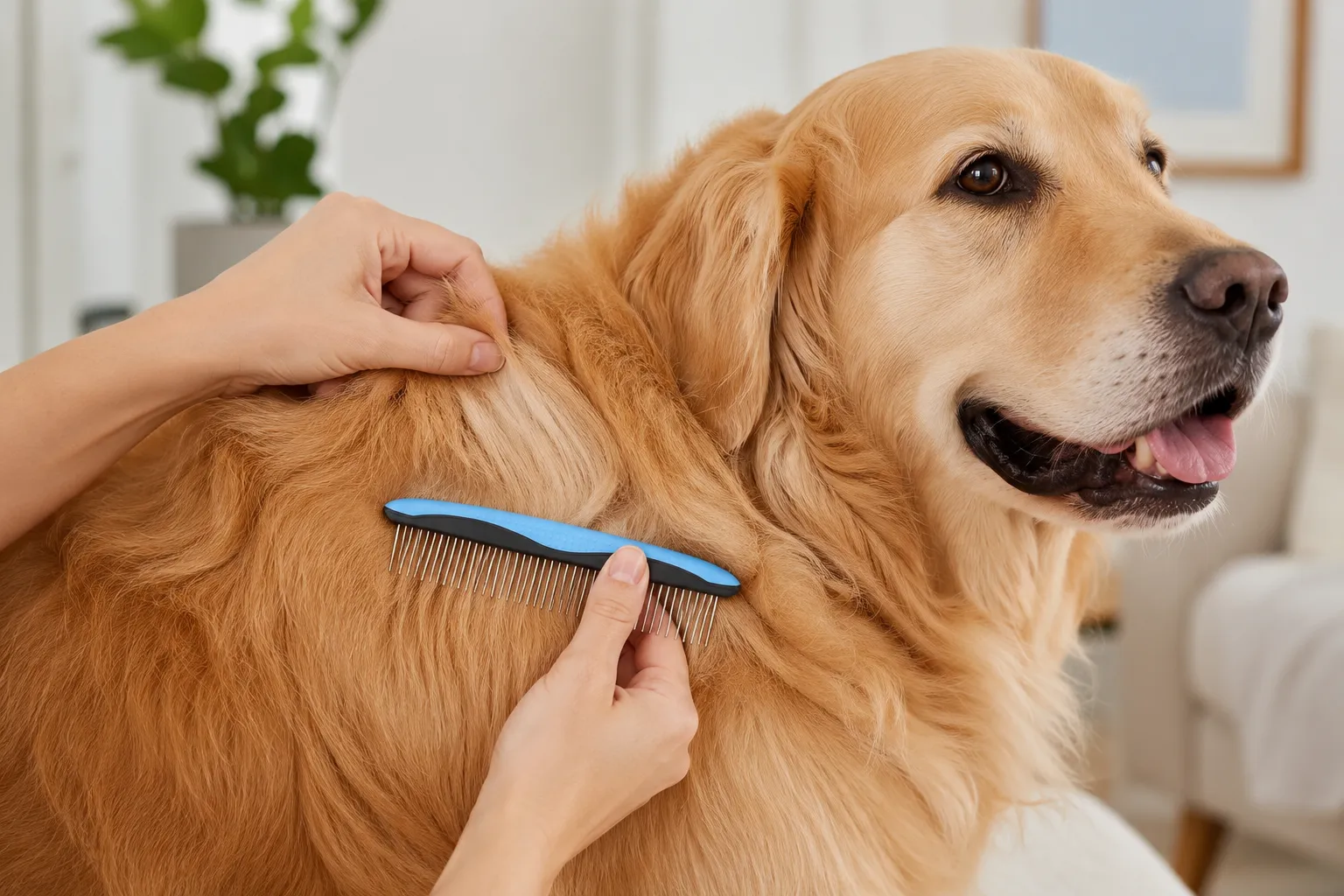
A metal grooming comb can find hidden tangles, collect loose hair, and check a section before or after other tools. Begin with the wider-spaced teeth and stop at every catch.
Quick Answer: Work on one small, visible section in the direction of hair growth. Start with the wider-spaced teeth. On suitable long fur, begin near the outer ends and move closer to the base only as the comb passes freely. If it catches, remove it and inspect the section instead of pulling harder. Use the finer teeth only after the wide section passes without force. Use the comb before an undercoat rake to find resistance and afterward to check the coat. Dense, painful, widespread, or skin-level mats need professional assessment.
What a Metal Grooming Comb Can Do
A metal comb can help you:
- check beneath the visible top layer;
- locate a small hidden tangle;
- collect loose hair;
- smooth a manageable, already-loosened section;
- inspect the coat before another tool;
- recheck after brushing or raking.
It is useful on medium, long, or dense coats where surface brushing may miss resistance. Short, sparse, curly, wire, or specialized coats may need another tool. A comb cannot safely remove every mat.

Wide Teeth First, Fine Teeth Later
As a cautious rule, start with the wider-spaced teeth to find where the coat stops moving freely.
Use the wide section for the initial check, manageable tangles, and pre- or post-rake inspection. Use the finer section later for loose hair and finishing.
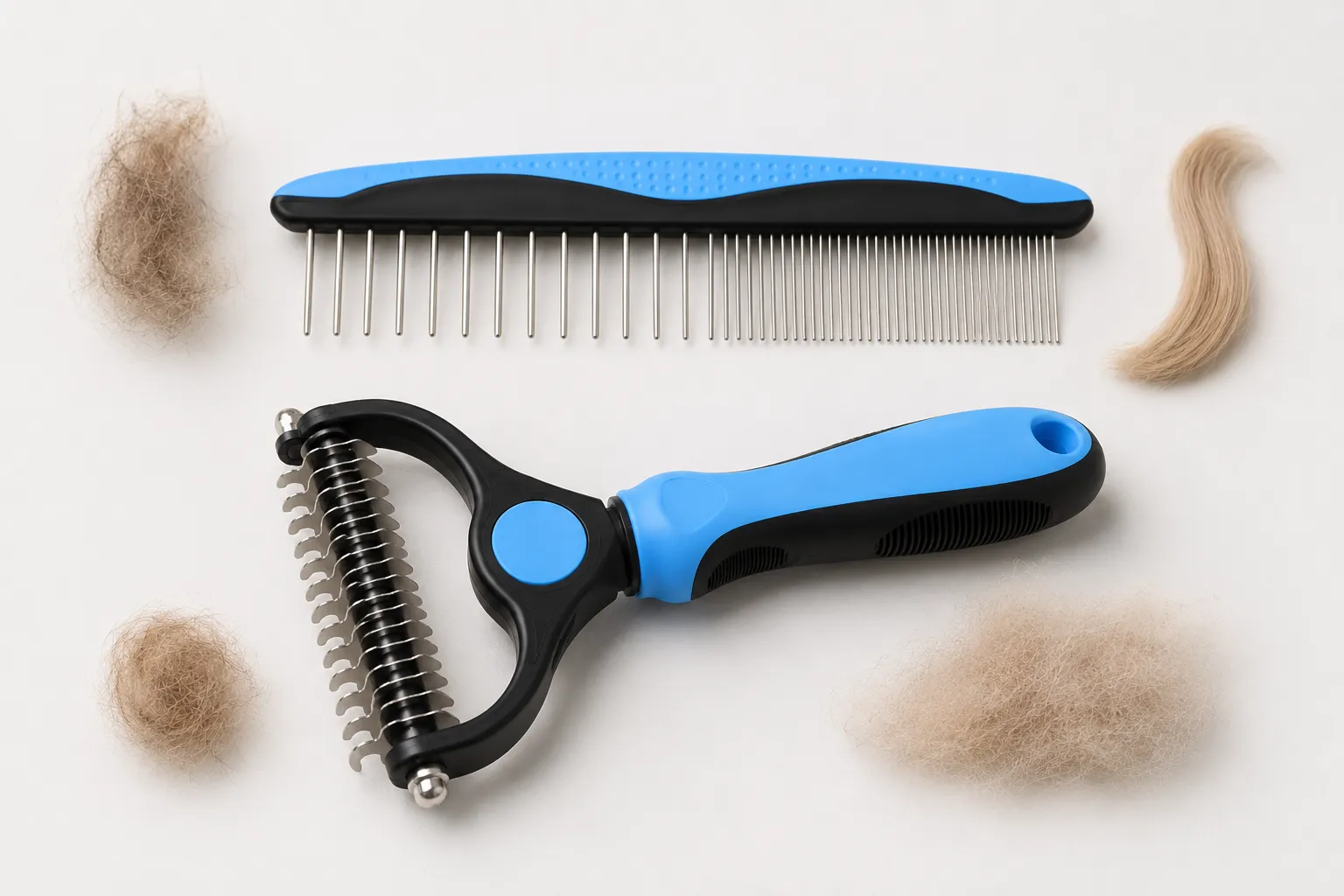
According to the Amazon seller’s description, the Docrok comb has wider and denser sections. The seller assigns the wider section to knots and smoothing and the denser section to loose-hair removal. These product-use claims do not prove that either section suits every coat or body area.
Fine teeth should never be pulled through a knot simply because they collect more hair.
How to Comb a Small Visible Section
Inspect the coat and skin first. Do not comb over wounds, redness, bleeding, pain, or other abnormal skin.
Then:
- Choose one section you can see and control.
- Part longer or thicker hair with your fingers.
- Begin with the wider-spaced teeth.
- Move generally with the direction of hair growth.
- On suitable long fur, start near the outer ends.
- Move toward the base only as the section becomes passable.
- Stop and remove the comb when it catches.
- Inspect the resistance with your fingers.
- Use fine teeth only after the wide section passes freely.
Use light pressure and avoid pressing the teeth into the skin. Do not twist the comb, use a sawing motion, or increase force.
For cats, stop for tail swishing, ears moving back, dilated pupils, body tension, or attempts to leave. For dogs, stop for flinching, pulling away, growling, snapping, or escape attempts. A quiet pet is not necessarily comfortable.
How the Comb Finds Hidden Tangles
Long or dense fur can look smooth while hiding resistance closer to the base. Lift or part the outer coat and work through a narrow visible section with the wide teeth.
A localized catch may indicate a tangle, trapped undercoat, or debris. Broad or repeated resistance may indicate dense matting.
The comb catching is information, not a pass-or-fail safety test. Remove it and inspect rather than pulling. Stop when the skin cannot be checked, the mat and skin move together, or the pet reacts painfully.
A dense, flat, widespread, or skin-level mat is outside routine home combing.
Use the Comb Before and After the Rake
Before raking, the wide comb section can locate resistance and obvious tangles.
After limited use of the 9-tooth side, recheck with the wide comb. If it still stops at dense resistance, do not repeatedly return to the rake.
After the 17-tooth side collects loose undercoat, use the wide teeth again to check whether the coat passes more freely and whether a hidden snag remains. Use the finer section only after the wide teeth pass.
With the Docrok grooming brush and metal comb combo, the comb can guide the decision about whether the coat needs a rake side, another light check, or no more work.
Limits, Stopping Signs, and Professional Help
A comb may offer more control than a rake, but it is not automatically appropriate for sensitive areas. Use extra caution around the face, eyes, ears, paws, armpits, belly, groin, tail, skin folds, and thinly coated areas.
End home combing when:
- the wide teeth cannot enter without force;
- the comb repeatedly catches;
- a mat is hard, flat, or close to the skin;
- the skin cannot be checked;
- the pet shows pain or escalating distress;
- the skin becomes red or irritated.
Do not cut a tight mat with scissors. Contact a professional groomer for dense, widespread, or pelted matting. Contact a veterinarian for pain, broken or abnormal skin, bleeding, dampness, discharge, unusual odor, or possible sedation needs.
Final Takeaway: Start wide, work one visible section, and stop at resistance. Use fine teeth only after the wide section passes. Judge completion by a freely passing coat, normal skin, and a comfortable pet.
As an Amazon Associate I earn from qualifying purchases.