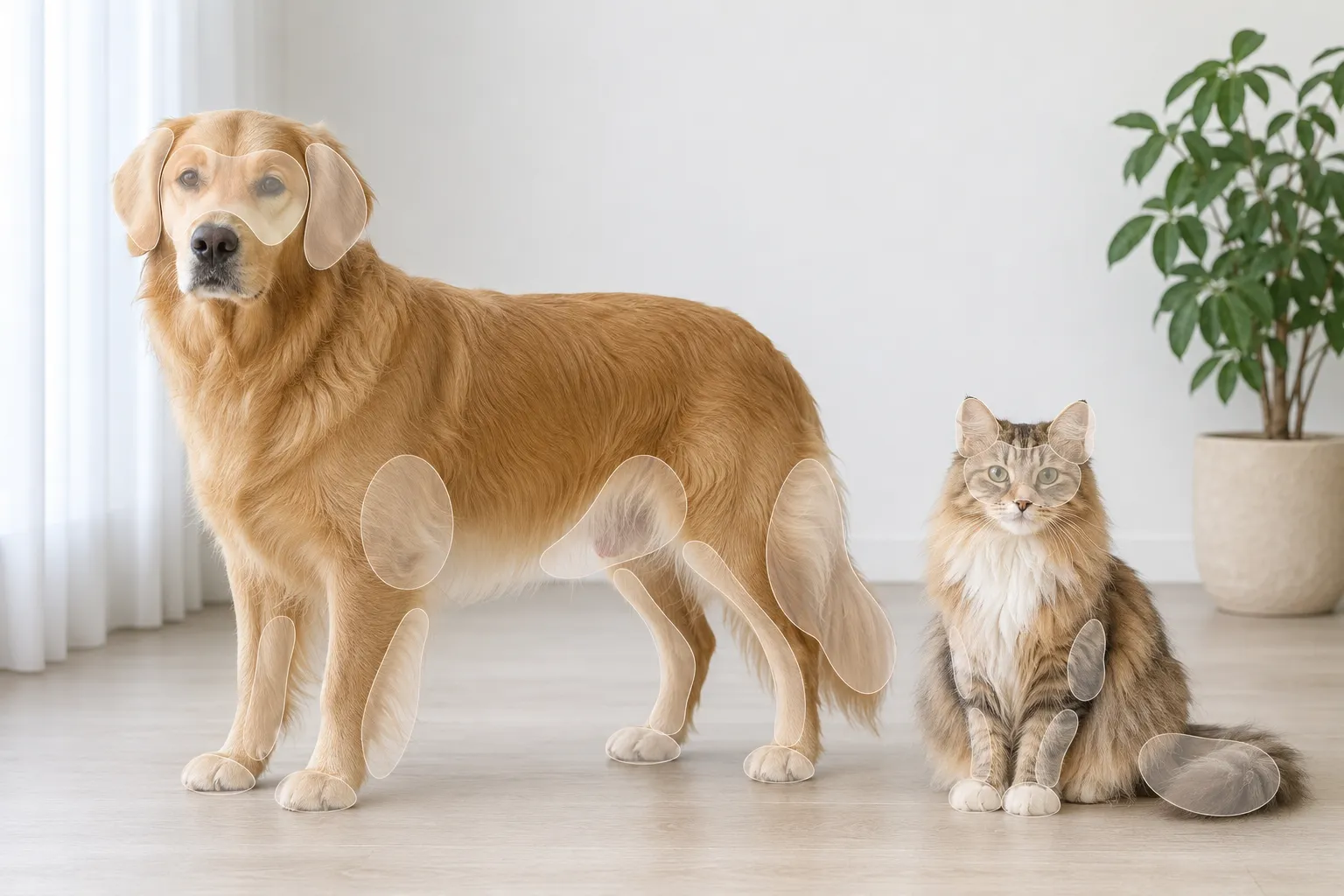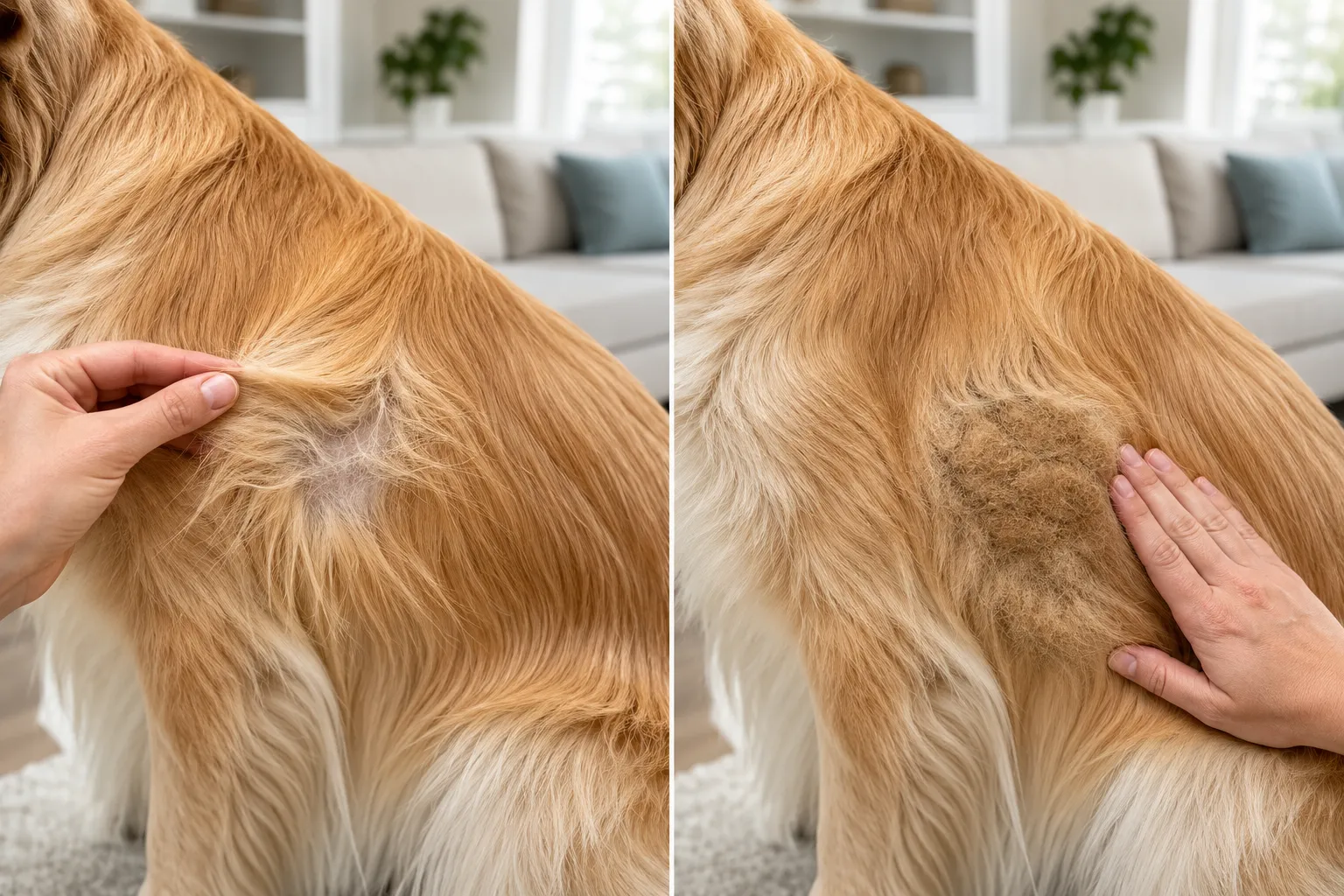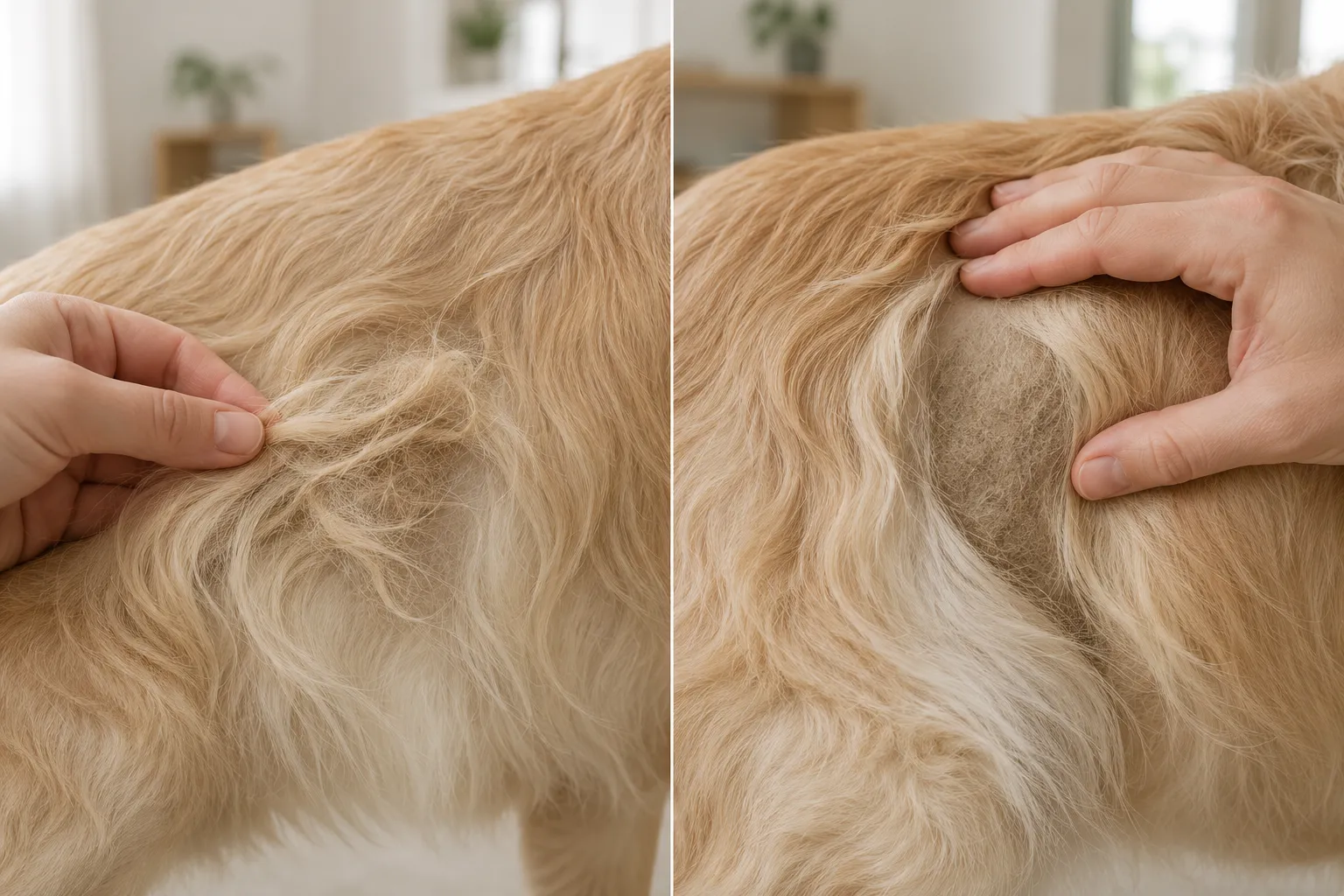
A mat has moved beyond routine home grooming when it is dense, flat against the skin, painful, widespread, or difficult to assess safely. A loose tangle may remain flexible and begin separating at the outer edge. A severe mat stays compacted, repeatedly traps the comb, or prevents you from checking the skin underneath.
Quick Answer: A mat is too tight for routine home grooming when it feels hard or flat against the skin, cannot be gently separated at the outer edge, prevents you from checking the skin, repeatedly traps the comb or rake, or causes the pet to flinch, pull away, or show pain. Stop if the skin is red, damp, sore, bleeding, or has an unusual odor. Do not force a dematting tool through the mat or cut it with scissors. Contact a professional groomer, and involve a veterinarian when pain or abnormal skin is present.
Signs a Mat Has Moved Beyond Routine Home Care
A mat is no longer a routine home-grooming problem when:
- It feels thick, hard, flat, or firmly attached.
- The outer edge does not begin to separate gently.
- The metal comb repeatedly stops or cannot enter without force.
- Moving the mat pulls the skin with it.
- The skin beneath the mat cannot be seen or checked.
- Several mats connect across a larger area.
- The coat feels like a sheet or shell rather than separate sections.
- The pet flinches, turns sharply, pulls away, growls, hisses, scratches, snaps, or tries to escape.
A small mat can still sit tightly against the skin or hide irritation. Repeated tool catching is a reason to stop, not increase pressure.
Why Skin Proximity Matters
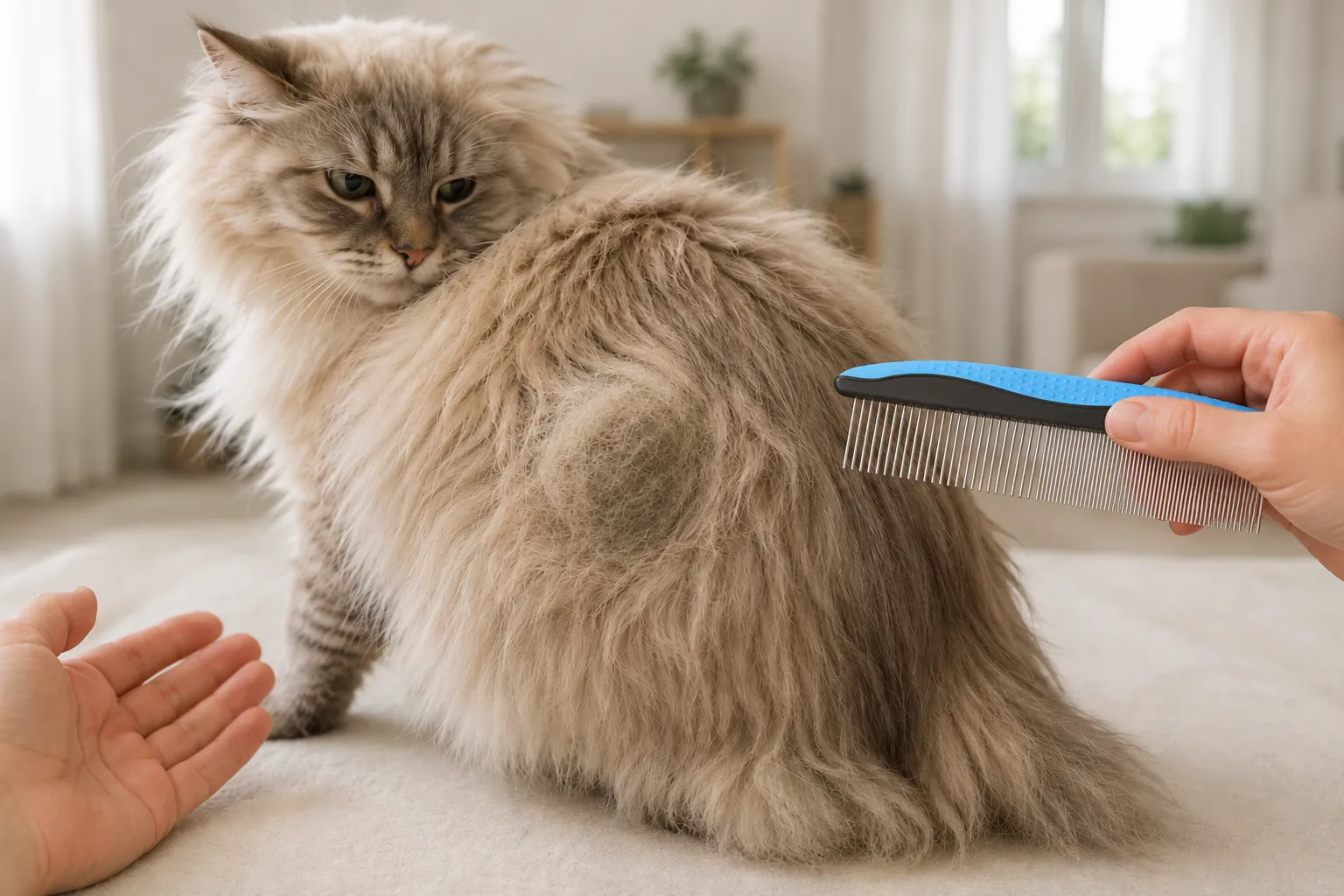
Mats can sit close to the skin, which may be pulled upward into the compacted hair and become difficult to see.
There is no reliable finger-width, coin-size, or comb-under-the-mat rule that proves home removal is safe.
Skin hidden beneath a mat may be red, damp, sore, or irritated. If it cannot be checked, do not insert sharp teeth, scissors, or another blade underneath. A mat that moves with the skin is also a stopping sign.
What Not to Try at Home
Do not cut a tight mat with scissors; hidden skin may be folded into the compacted hair. Do not force a comb, rake, or dematting edge through resistance. Do not bathe a tightly matted coat first, because wetting can make mats tighter. Do not restrain a distressed pet to continue.
Dense or skin-level matting requires trained assessment, not home scissors, clipping, shaving, or sedation.
Groomer or Veterinarian?
Contact a professional groomer when:
- the mat is dense or flat against the skin;
- the matting is widespread or pelted;
- several mats connect across a larger section;
- the skin appears normal, but the coat cannot be handled safely at home;
- the pet cannot remain comfortable enough for controlled grooming;
- trained coat removal may be needed.
A groomer may need to shorten part of the coat, and full coat length may not be preserved.
Contact a veterinarian when:
- the skin is red, broken, bleeding, damp, crusted, or has discharge;
- there is an unusual odor;
- the pet appears painful;
- the pet cannot tolerate handling;
- the pet is elderly, medically fragile, or has sudden worsening matting;
- sedation may be needed for safe treatment.
Pain, wounds, unusual sensitivity, and abnormal skin belong with a veterinarian.
Docrok Limits
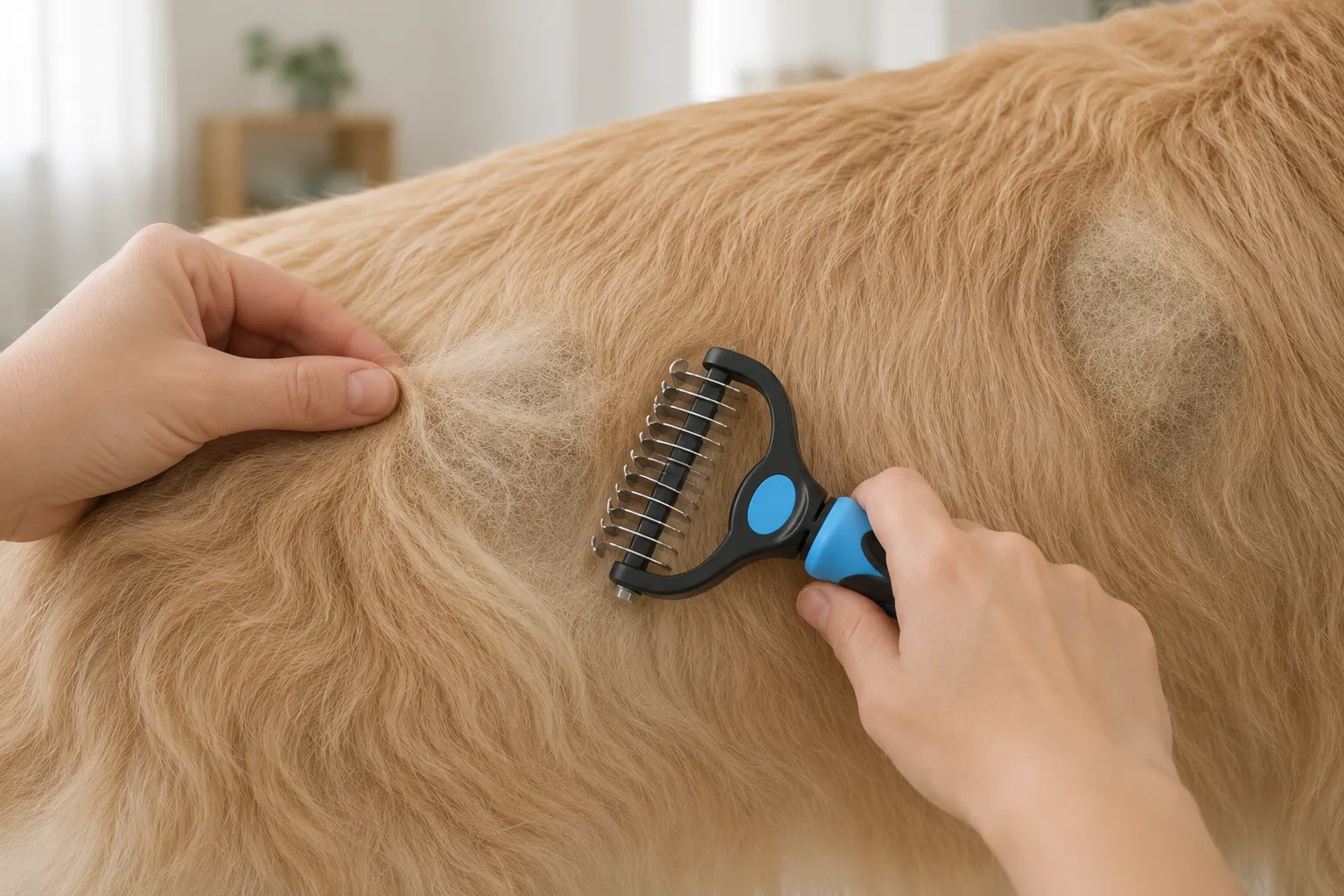
The Amazon listing markets the wide side of the Docrok rake for mats and tangles; project photographs confirm that this is the 9-tooth side.
That does not make it suitable for every mat. Limit the 9-tooth side to a clearly manageable tangle where the skin can be checked and the tool moves without force.
The included metal comb is a checkpoint, not a strength test. Stop if it catches repeatedly.
You can view the Docrok grooming brush and metal comb combo to see how the rake and comb are arranged.
Final Takeaway
Matted fur is too severe for home grooming when it is hard, skin-level, painful, widespread, repeatedly traps the tool, or hides abnormal skin. Stop before force becomes part of the process. Use a groomer for severe coat removal and a veterinarian for pain or abnormal skin.
As an Amazon Associate I earn from qualifying purchases.
Sources
- VCA Animal Hospitals — Grooming and Coat Care for Your Dog
- VCA Animal Hospitals — Grooming and Coat Care for Your Cat
- VCA Animal Hospitals — How to Groom a Long-Haired Cat
- PetMD — Pet Grooming: How to Handle Matting in Dogs and Cats
- American Kennel Club — Why It’s Worth Having Your Dog Groomed Professionally
- American Kennel Club — National Core Professional Dog Grooming Educational Standards
- Amazon — Docrok Pet Grooming Combo