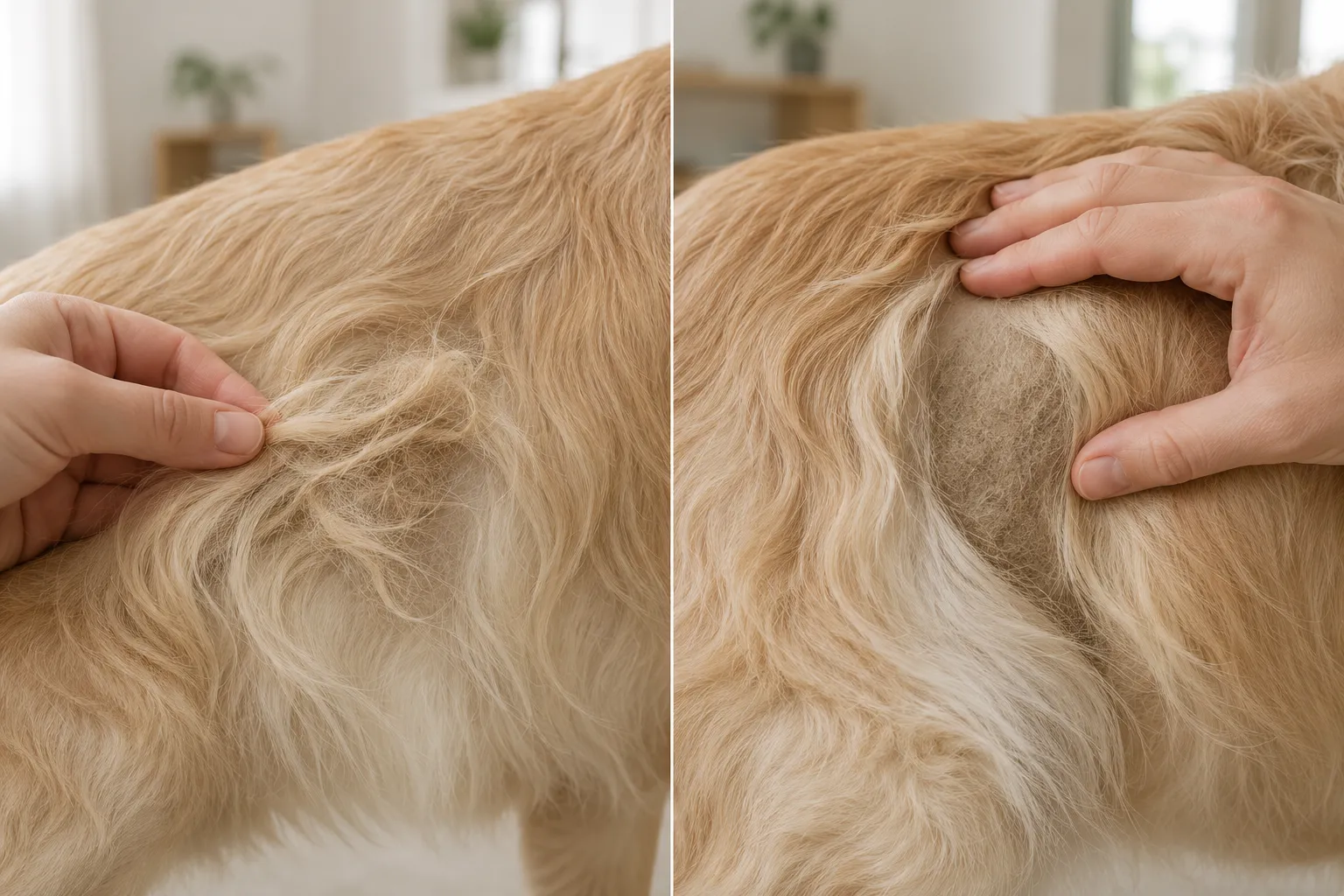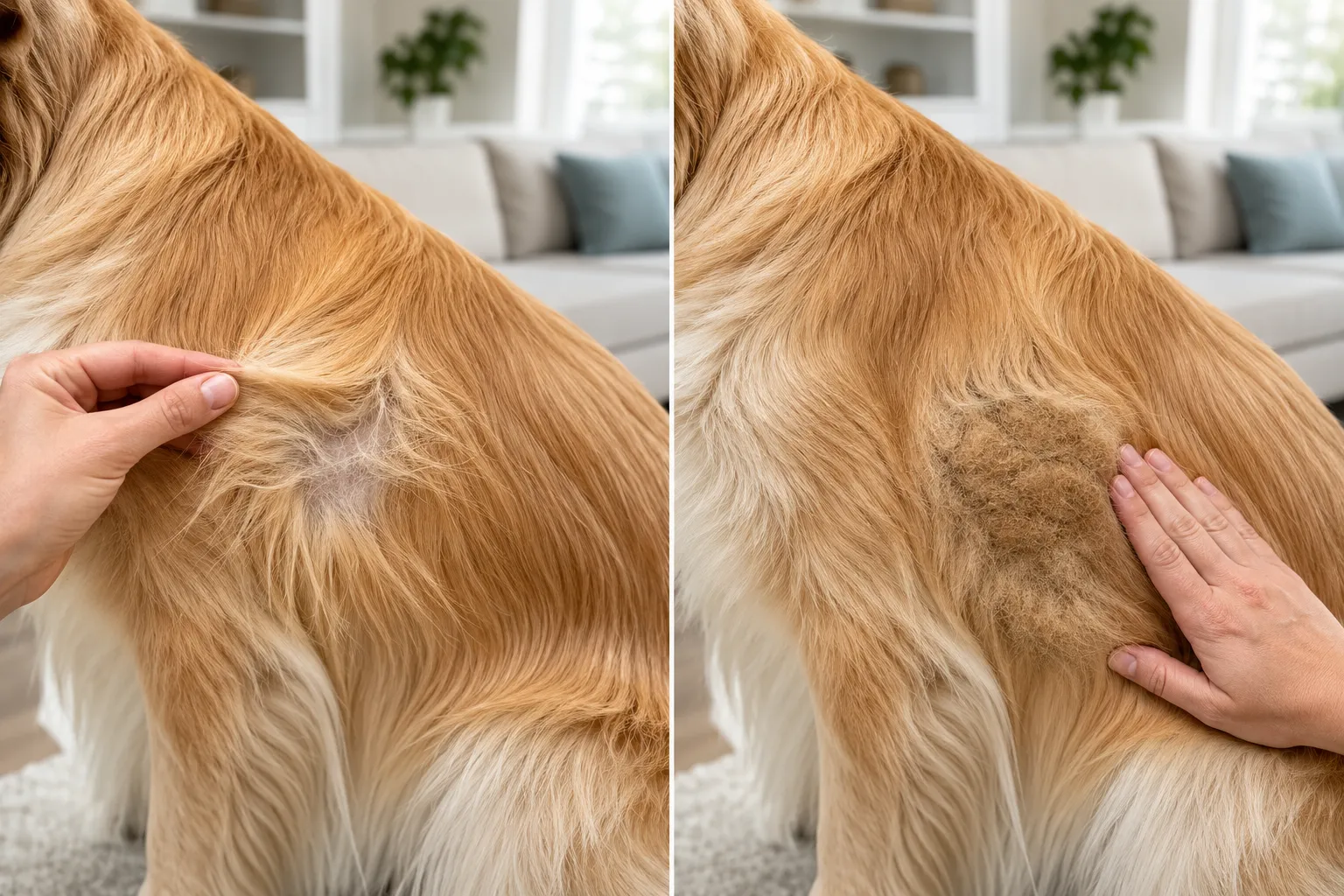
A light tangle may sometimes be managed at home, but a dense mat is different. Small size alone does not prove safety. Check whether the skin is visible, the outer hairs separate gently, the tool path stays clear, and the pet remains comfortable.
Quick Answer: A small tangle is usually localized, flexible, and loose enough that the outer hairs begin to separate gently while the skin can still be checked. A dense mat feels thick, hard, flat, or tightly compacted; may move the skin when lifted; and may prevent you from seeing or safely checking the skin underneath. Start with the wider-spaced metal comb and stop if it catches. Use the Docrok 9-tooth side only on a manageable tangle, never on a tight skin-level mat. Do not pull sharply or use scissors. Seek professional help for painful, widespread, or close-to-skin matting.
Resistance is information, not a reason to pull harder.
Light Tangle vs. Dense Mat
A light tangle is usually localized, flexible, separate from nearby tangles, and loose enough for some outer hairs to divide gently. The skin remains visible, and wider comb teeth can enter the outer edge without force.
A dense mat may feel thick, hard, or flat. It may sit close to the skin, move the skin when lifted, stop the wider comb, or connect with other mats.
Pelted coat is more severe: multiple mats form a broad sheet that prevents normal skin inspection. That is outside routine home grooming. A small mat can still be unsafe when it is tight or near a sensitive area.
Why Tangles Form and Where to Inspect
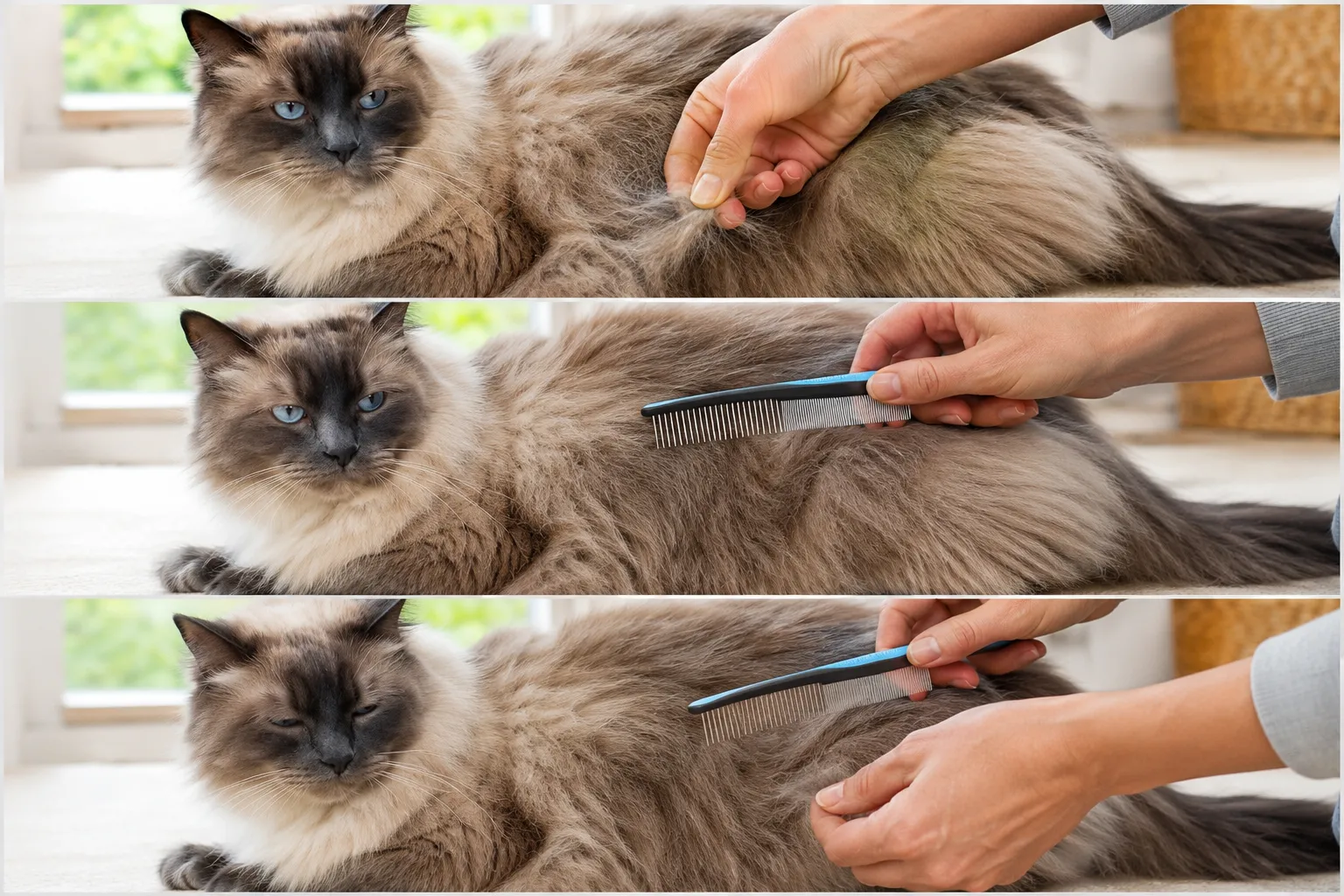
Tangles form when loose hair, attached hair, friction, moisture, dirt, or debris combine in the coat.
Common friction points include:
- behind the ears;
- under collars or harnesses;
- under the front legs;
- the chest;
- the backs of the legs;
- lower legs;
- areas where the legs rub against the body.
Long, silky, curly, wool-like, and dense double coats may tangle more readily. Pets with reduced mobility or self-grooming may also need closer checks.
These are inspection areas, not automatic rake areas. Do not use a dematting rake on the face, ears, paws, armpits, belly, groin, genital area, or other sensitive sections. Check tangles before bathing because wet compacted hair may tighten.
How to Judge Skin Proximity
No finger-width, millimeter, coin-size, or mat-diameter rule proves home removal is safe.
Treat a mat as too close to the skin when:
- it lies flat against the body;
- the base of the hair cannot be separated or seen;
- the skin cannot be inspected;
- the mat and skin move together;
- the wider comb cannot enter the outer edge without force;
- the pet reacts when the mat is moved;
- the intended tool path would be hidden.
“Skin moves with the mat” is a conservative stop sign, not a clinical test. Do not push a comb toward hidden skin, insert rake teeth blindly, pull the mat upward, or slide scissors underneath it.
When a Small Tangle May Be Managed Conservatively
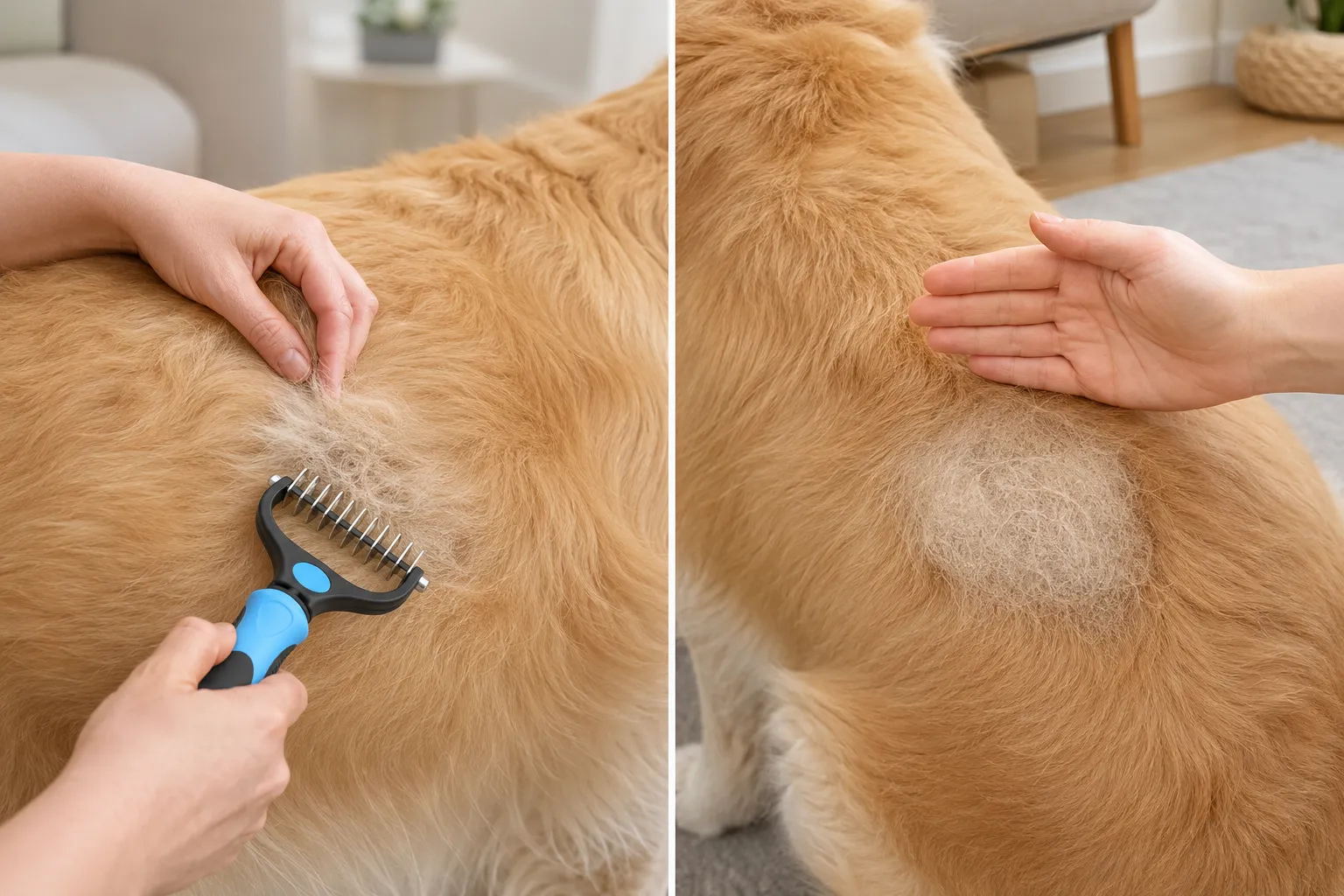
A localized tangle may be manageable only when the outer edge separates gently, the skin is visible and normal, the area is not sensitive, the pet remains relaxed, the wider comb enters without force, and the tangle is not connected to broader matting.
Inspect with your fingers, then use the wider-spaced comb as a checkpoint. If it catches, stop and inspect. Do not jerk, saw, twist, or increase pressure. Continue only while the outer edge loosens gently and the section remains controllable.
A quiet pet may still be uncomfortable. Watch for tension, flinching, turning toward the tool, tail swishing, ears moving back, or attempts to leave.
Metal Comb and Docrok 9-Tooth Roles
Use the wider comb section first to locate resistance and test the outer edge. Use the finer teeth only after the wider section passes freely.
According to the Amazon seller, the wide rake side is for mats and tangles, while the dense side is for deshedding. Project photographs confirm the 9-tooth and 17-tooth configuration.
Consider the 9-tooth side only when the tangle is clearly manageable, the skin is visible, and the tool moves without force. The 17-tooth side is for loose undercoat on a tangle-free section, not mat removal.
You can view the Docrok grooming brush and metal comb combo to see the 9-tooth, 17-tooth, and comb configuration.
When to Stop and Seek Professional Help
Stop when the tool catches repeatedly, the mat is hard or flat, the skin moves with it, the skin cannot be checked, more pressure seems necessary, abnormal skin appears, or the pet becomes distressed.
Contact a professional groomer for dense, skin-level, widespread, connected, pelted, or sensitive-area matting. Contact a veterinarian for broken, bleeding, damp, discharging, odorous, or painful skin, or when a medical concern may be hidden beneath the mat.
Do not cut a tight mat with scissors or attempt home clipping, shaving, or sedation.
Final Takeaway
A manageable tangle is flexible, localized, visible, and passable at the outer edge without force. Start with the wider comb and consider the 9-tooth side only while the area remains controllable. Dense, skin-level, widespread, or pelted matting belongs with a professional.
As an Amazon Associate I earn from qualifying purchases.
Sources
- VCA Animal Hospitals — Grooming and Coat Care for Your Dog
- VCA Animal Hospitals — Grooming and Coat Care for Your Cat
- VCA Animal Hospitals — How to Groom a Long-Haired Cat
- PetMD — Pet Grooming: How to Handle Matting in Dogs and Cats
- RSPCA — How and Why to Groom Your Cat
- Cat Friendly Homes — Home Environment Modifications
- Amazon — Docrok Pet Grooming Combo